Rosh Hashanah Morning 5787 – Rabbi Gersh Lazarow
As some of you know, my mother has spent different periods of her life teaching people how to swim.
It was never her vocation, but it has always been one of her great passions, and she is remarkably good at it.
Even now, I regularly meet people who realise the family connection and immediately say, “Your mother taught me to swim,” usually followed by a story that suggests they remember the experience rather vividly.
Growing up as the son of a swimming teacher meant absorbing all sorts of lessons about water, but there is one that has stayed with me because it seemed so counterintuitive.
If you find yourself stranded in open water, the instinct is to tread water. You keep your head above the surface, look around, try to orient yourself and wait until you know where safety lies.
Except treading water is exhausting. Almost every muscle in your body is working simply to keep you exactly where you are, and eventually fatigue sets in. So there comes a point, Mum taught me, when even if you cannot see the shore clearly, you have to choose a direction and swim. Not because the water has suddenly become safer or because you know with certainty that you are heading in the right direction, but because once you begin moving there is at least the possibility that you are getting somewhere.
I have thought about that lesson a great deal this year, because I think many of us have spent an enormous amount of energy simply keeping our heads above water.
As we swim through the murky waters we’ve all faced since October 7, we were asking ourselves “how bad is antisemitism becoming in Australia?”. And eventually that question became: what kind of Jewish future is actually possible here?
We wonder about children spending their school years behind fences and security guards, about whether to wear a Magen David on the tram, about the exhausting qualifications that sometimes seem necessary before we can speak about Israel or simply express our connection to our people.
And increasingly, I hear people looking backwards through their family trees. Was Grandma Hungarian? Could Dad get a German passport? Is there another citizenship available somewhere that perhaps we should organise for the children?
Just in case.
There is something particularly unsettling about Australian Jews saying those words because, for so many of our families, Australia was the “just in case”.
And yet graffiti and intimidation became attacks on people and property, a synagogue in our own city was firebombed, and antisemitic ideas that once belonged on the margins became increasingly normalised.
And then came Bondi.
In the months since, through testimony and reportage and now through the Royal Commission, Australia has begun hearing publicly what many Australian Jews were already discussing privately: something has changed, and beneath all the questions about politics and policing lies a far more intimate one about whether we can continue to live here not merely safely, but openly, confidently and joyfully as Jews.
Jewish history has taught us the limitations of believing any answer to that question is permanent. The more enduring Jewish question has always been: wherever we find ourselves, what are we going to build?
Sometimes, of course, we need to tread water while we work out where we are.
But we cannot tread water forever.
Which is perhaps why Rosh Hashanah arrives with precisely the words we need.
Later this morning, around the sounding of the shofar, we will say:
הַיּוֹם הֲרַת עוֹלָם
We often translate those words as “Today is the birthday of the world,” but harat is really the language of pregnancy, of gestation, of something waiting to be born.
Hayom harat olam. Today the world is expectant.
Rosh Hashanah does not ask us to forget the year we have lived. We bring it all into this room with us: Bondi and Israel, our grief and anger, our fear for our children and our uncertainty about this country we love.
But then the machzor reminds us that the future has not yet been born.
And so the question cannot only be, What is going to happen to us?
It must also be, What are we going to do with what has happened to us?
For all that feels unprecedented about this moment, we are hardly the first generation of Jews to ask that question. These fears are almost as old as our people itself, and because Judaism has never been afraid to tell the truth about the realities of Jewish life, they found their way into our sacred texts.
The biblical prophet Jeremiah lived through one of those moments. Jerusalem was under siege, the Babylonian army was outside the walls, and Jeremiah, who had spent years warning that the city would fall, knew precisely how bad things were.
And then his cousin arrived with perhaps the worst-timed real-estate proposition in Jewish history: there was a family field at Anata, and Jeremiah had the right to buy it.
The city was surrounded. Exile was coming.
And God told him to buy the field.
So Jeremiah weighed out the silver, signed and sealed the deed, gathered witnesses and arranged for the documents to be preserved for the future.
Why?
Because God tells him:
עוֹד יִקָּנוּ בָּתִּים וְשָׂדוֹת… בָּאָרֶץ הַזֹּאת
“Houses and fields… will once again fill this land.”
Jeremiah does not buy the field because everything is fine.
He buys it precisely because everything is not fine; because one terrible moment does not get to become the whole story, and because somebody has to make a decision today that belongs to tomorrow.
Somebody has to make a decision today that belongs to tomorrow.
I love that. Because that is Judaism!
Again and again, we have refused to allow the most difficult moment in our story to become its final chapter.
And that is the choice we have been wrestling with at Shtiebel.
Four years ago, we began with a fairly simple proposition: perhaps Jewish community could feel different. Perhaps belonging could come before obligation; perhaps we could be deeply rooted in tradition without demanding uniformity; perhaps we could take Torah seriously without always taking ourselves so seriously.
And you came.
You came for Shabbat and learning, baby namings and B’Mitzvah, weddings and conversions, music and meals. Some came already deeply connected to Jewish life, while others came because they had stopped believing there was a Jewish place for them.
Slowly, relationship by relationship, an experiment became a community and along the way we have learned something that I think is enormously important: people are not looking only for Jewish institutions. They are looking for Jewish life. They are looking for places where they can belong, create, learn, celebrate, question, eat, sing, bring their children, bring their friends and simply be themselves.
Our humble Shtiebel on Booran Rd has taught us that. The kitchen and the books, the courtyard and the couches, children wandering around and conversations spilling between rooms have helped create something that feels more like a home than an institution.
And as days like today demonstrate we are quickly out growing it.
So the question became whether we would continue making do, waiting for the world to become calmer and the future more certain, or whether this was precisely the moment to take everything we have learned and build towards what comes next.
Eventually, you have to stop treading water.
Jeremiah bought his field.
And so have we.
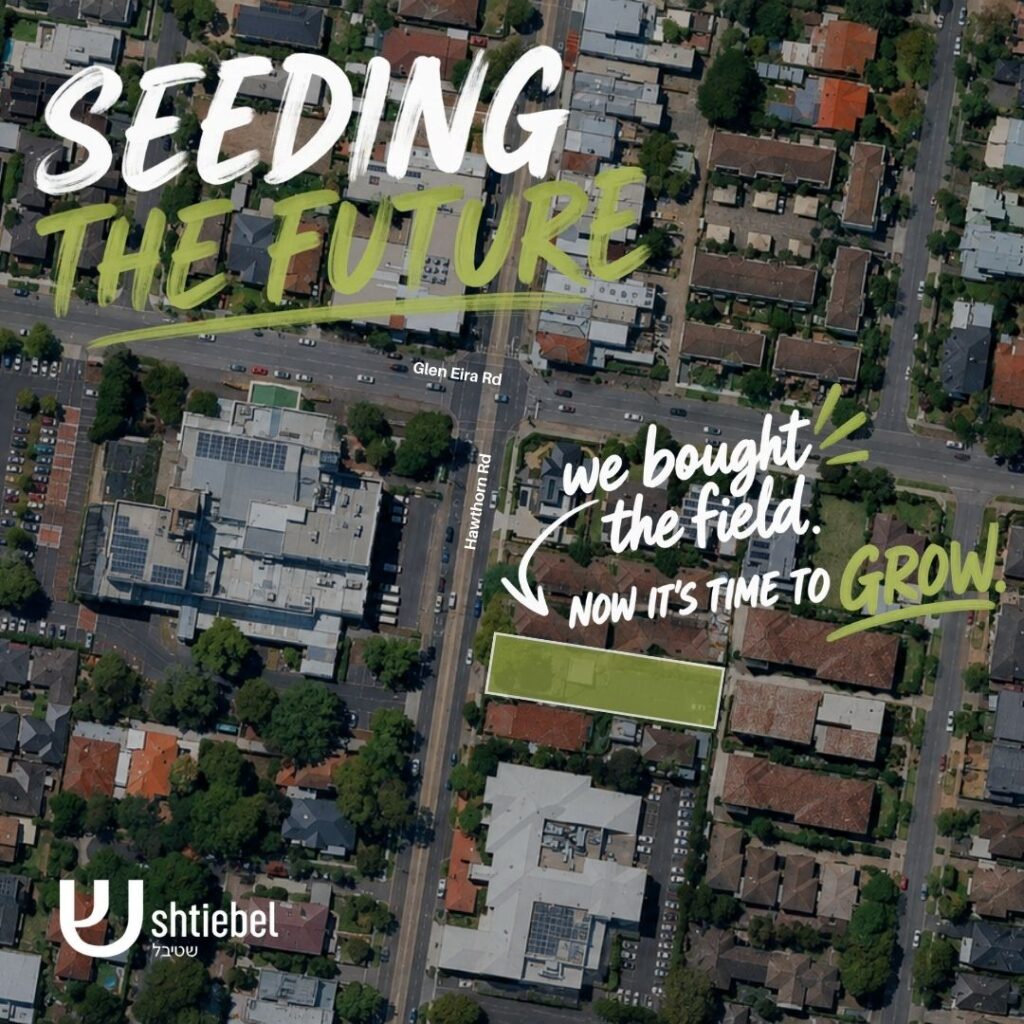
On 1 February, Shtiebel will settle on the purchase of 281 Hawthorn Road, which will become our permanent home and the future Shtiebel Cultural Centre.
We have bought the field.
And I cannot tell you how excited I am about what that makes possible.
Because we are not simply buying ourselves a bigger Shtiebel, and we are certainly not setting out to build another synagogue. What we have the opportunity to create is a genuinely different kind of Jewish home for Melbourne.
The Shtiebel Cultural Centre will be a place where Jewish life can be encountered in all of its richness: through learning and literature, music and art, food and film, performance and conversation, festivals and celebrations. It will give our library a permanent home and create space for writers and artists, musicians and educators, children and families, community organisations and cultural partners to create things that we have not even imagined yet.
Of course there will be Torah and prayer, Shabbat and festivals, B’Mitzvah and weddings, because they are part of who we are, but the doors will be wider than that. I want somebody who would never think to walk into a synagogue to walk into an exhibition, a concert, a lecture, a film, a meal or simply for coffee, and somewhere along the way discover that Jewish community might belong to them too.
I can already see the place alive: books finding their way onto the shelves, children running through a building that belongs to them, Torah being studied in one room while music is rehearsed in another, somebody cooking, somebody arguing, an artist hanging work on a wall, friends sitting around a table and someone walking through the front door for the first time wondering whether this place is really for them.
And discovering that it is.
That is why now.
Because after a year in which so much of the conversation about Jewish life has been about what threatens us, I want us to talk about what inspires us. When so much energy is being directed towards protecting Jewish life, as it absolutely must be, we also need to invest in actually living it.
Of course we will protect this place. We will do everything responsible leadership requires of us.
But our focus on safety and security must be balanced by an equally determined focus on Jewish life
I do not want another generation of Jewish children to believe that the defining architecture of Judaism is the fence around their school, and I refuse to give those who hate Jews the power to determine what Jewish life looks like.
Our answer to fear cannot simply be more safety and security.
It has to be more life.
More learning, more culture, more creativity, more community, more Judaism lived proudly and joyfully and without apology.
So this morning is a very big announcement, but it is really only the beginning.
On your way out today, we have a small gift for you: a few native wildflower seed balls to take home, plant and hopefully watch grow through the spring.
With them is a card and a QR code that will take you to a website where you can discover everything you want to know about 281 Hawthorn Road, about our plans for the Shtiebel Cultural Centre, and about what we believe this place might become.
But more importantly, it is an invitation to become part of the conversation.
Take the seeds home. Plant them. And then read, talk, question and dream with us, because over the months ahead we are going to invite this entire community to help imagine this place, shape it, support it and ultimately build it.
We have bought the field.
Now it is time to sow the seeds of what comes next.
And so I come back to my mother, and to the lesson she taught me all those years ago.
I cannot promise that the water will become calmer this year, or that we can already see the shore, but I have never been more convinced that there is somewhere worth swimming towards.
Jeremiah chose his direction.
We have chosen ours.
הַיּוֹם הֲרַת עוֹלָם
The future is waiting to be born. We have bought the field. Now, come swim with us.
Image credit:
We Bought The Field is based on satellite photo sources by Rabbi Gersh Lazarow. The accompanying title treatment and graphic design were created with the assistance of OpenAI’s ChatGPT, preserving the original photograph while enhancing it for publication.
About the Author
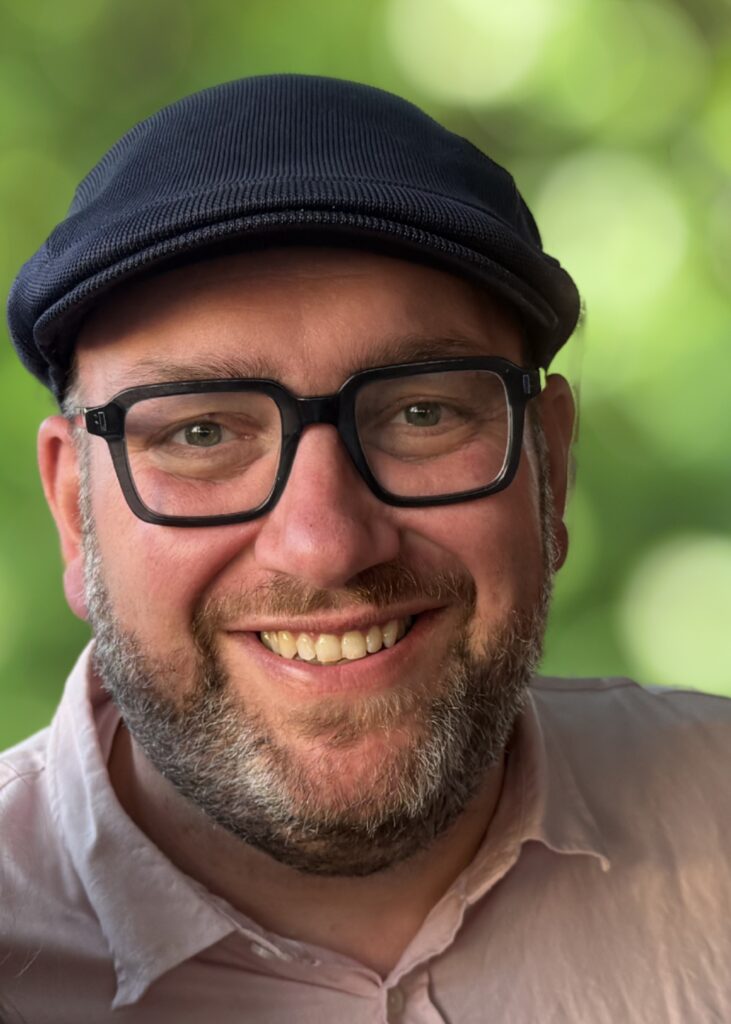
Rabbi Gersh Lazarow is the founding rabbi of Shtiebel, an independent Jewish community in Melbourne dedicated to openness, belonging, and the belief that every person should be empowered to “do Jewish their way.” His work brings together tradition, contemporary thought, and a deep commitment to helping individuals and families celebrate, learn, and live Jewishly with integrity and joy. With more than two decades of communal leadership, teaching, and pastoral work, Rabbi Lazarow is recognised for his thoughtful voice, accessible teaching, and his passion for creating spaces where people can shape meaningful Jewish lives on their own terms. As with much of his writing at Shtiebel, he shaped this piece with the help of AI as an editorial companion — a tool that helps clarify language but not intention. The spirit, teaching, and reflection remain wholly his own.