
An Essay On Zionism, B’tzelem Elohim, and the Evolution of a Prayer By Rabbi Gersh Lazarow
Over the better part of the past year, I have been writing and rewriting a prayer for those who serve in defence of Israel. It now exists in several forms, some considerably shorter than the full version, and it has changed as I have prayed it in different settings, returned to particular words, removed others, and discovered that some of what I originally wanted to say no longer quite expressed what I needed to pray.
I am not sure I regard even this version as finished. That does not trouble me terribly. Jewish prayer has never really been static. We inherit words, carry them into new circumstances and, occasionally, discover that the words themselves need to stretch.
The prayer is deliberately in conversation with the traditional Mi Sheberach for the soldiers of Israel. That prayer feels considerably older than it is because its language and structure are so recognisably Jewish. Its familiar modern form was composed by Rabbi Shlomo Goren, the first Chief Rabbi of the IDF, in the early years of the State, using the ancient Mi Sheberach form to give liturgical expression to an entirely new reality in Jewish history: Jewish sovereignty accompanied, for the first time in almost two millennia, by a Jewish army charged with defending it.
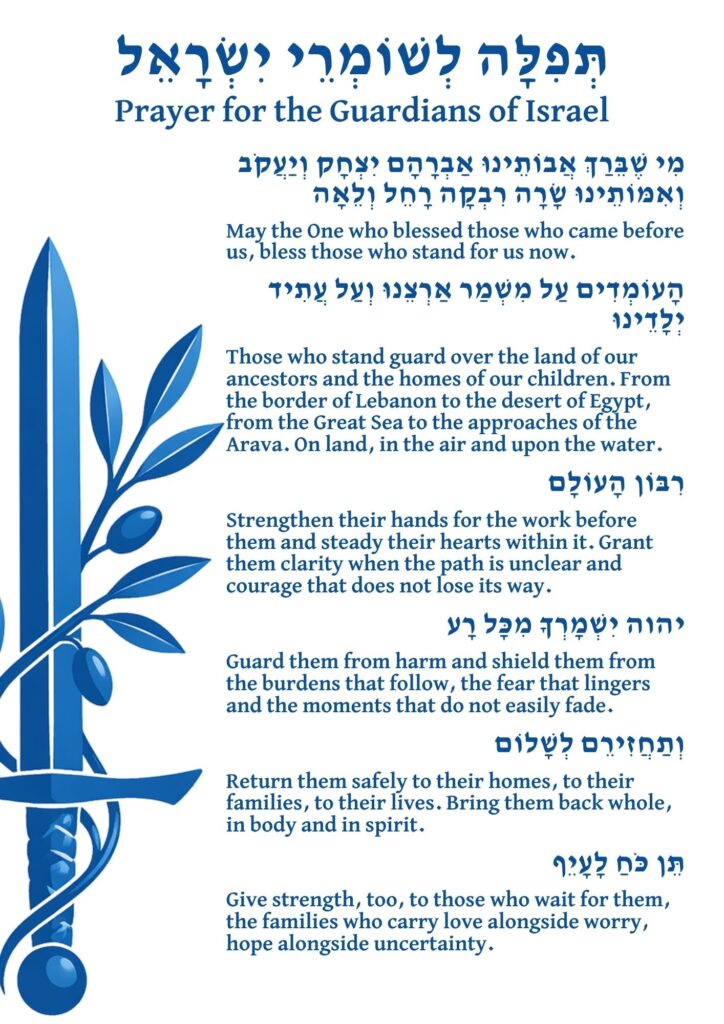
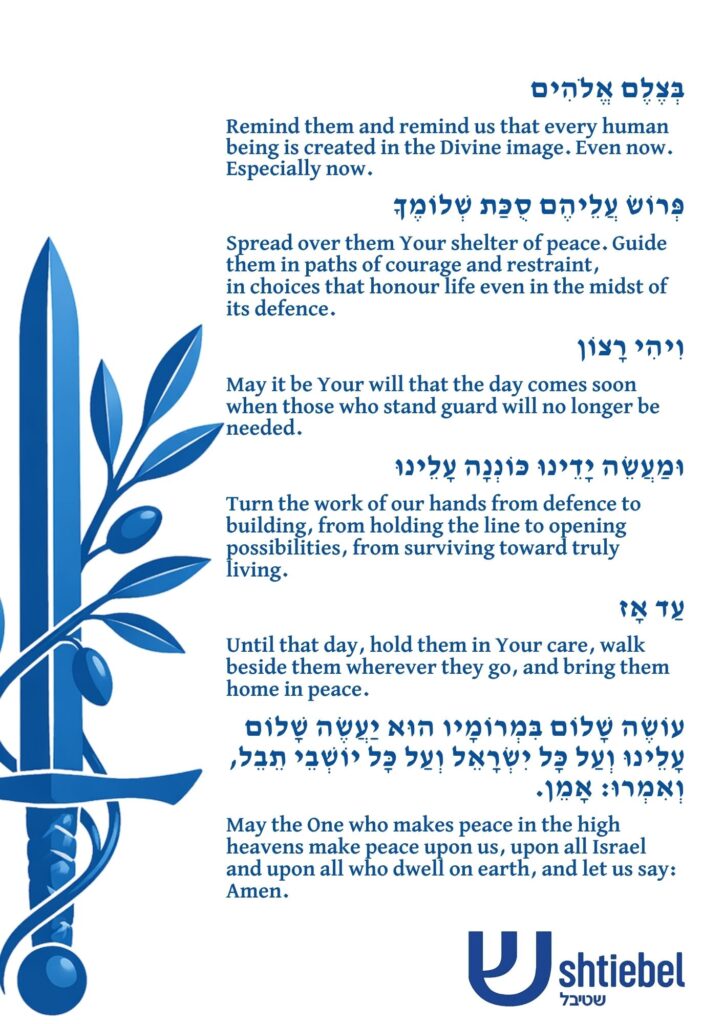
What I have written is not intended as a rejection of that prayer. In many respects it is an extension of it. Its opening makes the relationship explicit:
מִי שֶׁבֵּרַךְ אֲבוֹתֵינוּ אַבְרָהָם יִצְחָק וְיַעֲקֹב, וְאִמּוֹתֵינוּ שָׂרָה רִבְקָה רָחֵל וְלֵאָה
Mi shebeirach avoteinu Avraham, Yitzchak v’Yaakov, v’imoteinu Sarah, Rivkah, Rachel v’Leah.
May the One who blessed our ancestors Abraham, Isaac and Jacob, and our ancestors Sarah, Rebecca, Rachel and Leah.
The inclusion of the matriarchs is an obvious progressive development of the traditional formula, but otherwise the structure is immediately recognisable. We begin by locating those for whom we pray within a chain of Jewish memory. They are not simply soldiers or representatives of a state; they stand within the continuing story of a people.
The next phrase comes more directly from the traditional prayer:
הָעוֹמְדִים עַל מִשְׁמַר אַרְצֵנוּ וְעָרֵי אֱלֹהֵינוּ
Ha’omdim al mishmar artzeinu v’arei Eloheinu.
Those who stand guard over our land and the cities of our God.
In my English I have rendered and expanded that as “those who stand guard over the land of our ancestors and the homes of our children.” The geography that follows likewise retains the sweep of Goren’s prayer: from the border of Lebanon to the desert of Egypt, from the Great Sea to the approaches of the Arava, on land, in the air and upon the water.
I wanted to retain that geography because the land matters to me. I am a Zionist. I believe that the Jewish people are a people and not merely the adherents of a religion; that we have a profound historical, spiritual and cultural relationship with this land; and that we possess the same right to collective self-determination that I believe belongs to other peoples. I also believe that Israel has both the right and the responsibility to protect those who live within it.
Where my prayer begins to depart from the inherited text is not in its commitment to those who serve, but in the questions I increasingly need to place alongside that commitment. The traditional prayer asks God to send:
בְּרָכָה וְהַצְלָחָה בְּכָל מַעֲשֵׂה יְדֵיהֶם
Bracha v’hatzlacha b’chol ma’aseh yedeihem.
Blessing and success in all the work of their hands.
In the context of war, I have found myself unable simply to pass over that phrase. What exactly do I mean when I ask God to bless the work of a soldier’s hands? What constitutes success? What am I asking God to strengthen, and towards what end?
The Hebrew heading I use at this point is:
רִבּוֹנוֹ שֶׁל עוֹלָם
Ribono shel olam.
Master of the Universe.
It is not a quotation from a single biblical verse, but belongs to the familiar vocabulary of Jewish supplication. Having begun within the inherited Mi Sheberach, the prayer now moves into petition: “Strengthen their hands for the work before them and steady their hearts within it. Grant them clarity when the path is unclear and courage that does not lose its way.”
I want those who defend Israel to have strength, but I cannot pray only for strength. I need also to pray for judgement, restraint and moral clarity in circumstances in which clarity can be desperately difficult to maintain. There is courage in moving towards danger, but there can also be courage in restraint, in recognising limits, and in retaining the capacity to see the human being on the other side of the line. The moral question does not disappear because the military question has become urgent. If anything, the possession of power makes it more urgent.
The next Hebrew phrase comes directly from Psalm 121:
יְהוָה יִשְׁמָרְךָ מִכָּל רָע, יִשְׁמֹר אֶת נַפְשֶׁךָ
Adonai yishmorcha mikol ra, yishmor et nafshecha.
God will guard you from all harm; God will guard your soul.
The psalm continues:
יְהוָה יִשְׁמָר צֵאתְךָ וּבוֹאֶךָ מֵעַתָּה וְעַד עוֹלָם
Adonai yishmor tzetcha uvo’echa, mei’atah v’ad olam.
God will guard your going out and your coming in, from now and forever.
The language is familiar enough that it is easy to overlook how much it contains. In the context of this prayer, the movement from protection against harm towards the guarding of the nefesh has become particularly important to me.
When we pray for those who serve, our first instinct is understandably to pray for physical safety. We want them protected from injury and death and returned to the people who love them. Yet physical survival is not the only meaning of coming home safely. There are experiences that remain long after the immediate danger has passed, things witnessed that cannot simply be unwitnessed, decisions made under impossible circumstances and fear that does not necessarily disappear when the uniform comes off.
So the prayer extends the biblical petition: “Guard them from harm and shield them from the burdens that follow, the fear that lingers and the moments that do not easily fade. Return them safely to their homes, to their families, to their lives. Bring them back whole, in body and in spirit.”
The word “whole” matters. I am not simply praying that they survive. I am praying, in the language suggested by the psalm itself, for the person and for the nefesh.
The prayer then asks:
וְתַחֲזִירֵם לְשָׁלוֹם
V’tachazireim l’shalom.
Return them in peace.
This language sits naturally within Jewish prayer because departure and return are repeatedly imagined through the vocabulary of shalom. Most obviously, Tefillat HaDerech, the Traveller’s Prayer, asks:
וְתוֹלִיכֵנוּ לְשָׁלוֹם וְתַצְעִידֵנוּ לְשָׁלוֹם וְתַדְרִיכֵנוּ לְשָׁלוֹם
V’tolicheinu l’shalom, v’tatz’ideinu l’shalom, v’tadrichenu l’shalom.
Lead us towards peace, direct our steps towards peace, and guide us towards peace.
Here, however, the return I am imagining is not simply geographical. To return l’shalom must also mean returning to the possibility of life beyond war.
At that point the prayer widens, moving from those who serve to those who wait for them:
תֵּן כֹּחַ לַיָּעֵף
Ten koach la’ayef.
Give strength to the weary.
This is not a direct quotation from Isaiah, but a deliberate adaptation of Isaiah 40:29:
נֹתֵן לַיָּעֵף כֹּחַ וּלְאֵין אוֹנִים עָצְמָה יַרְבֶּה
Noten la’ya’ef koach, ul’ein onim otzmah yarbeh.
God gives strength to the weary and increases the strength of those without power.
I have taken the prophet’s description of God and turned it into petition. If God is the One who gives strength to the weary, then give strength now to those who are weary: to those who serve, certainly, but also to “the families who carry love alongside worry, hope alongside uncertainty.”
That movement from inherited text into contemporary petition happens repeatedly throughout the prayer. I have not been interested in assembling a collection of biblical quotations, nor in giving contemporary political ideas a decorative Hebrew veneer. I have tried instead to allow the language of Tanakh and the siddur to become the vocabulary through which the prayer thinks. Sometimes that means quoting a text directly; sometimes changing a pronoun or grammatical form; sometimes turning a biblical description of God into something we ask of God; and sometimes writing new language that consciously inhabits the rhythms of Jewish prayer.
Ten koach la’ayef has also become deeply personal during the period in which I have been writing this prayer. I have become the parent of a child who heard what she understood to be a generational call to service, and that has inevitably changed the way I hear words I have said throughout my rabbinate. “Guard them from harm” is different when I know the face that enters my mind as I say it. “Return them safely to their homes, to their families, to their lives” is different when one of those homes is ours. Asking for strength for those who wait carries a different weight when I have begun, in however small a way, to understand the peculiar combination of pride, love, distance and worry contained within that waiting.
I say that with caution. There are families whose experience of waiting has involved levels of fear, uncertainty and loss that I pray never to know, and I would never collapse my experience into theirs. What has changed for me is simpler: the person inside a uniform has become impossible to abstract. Each is somebody’s child, sibling, partner, parent or friend; somebody whose message is awaited, whose silence is noticed and whose empty chair changes a room.
Perhaps because that has become so personal, the next movement of the prayer has become even more important to me:
בְּצֶלֶם אֱלֹהִים
B’tzelem Elohim.
In the image of God.
The phrase comes from the opening chapter of Genesis:
וַיִּבְרָא אֱלֹהִים אֶת הָאָדָם בְּצַלְמוֹ, בְּצֶלֶם אֱלֹהִים בָּרָא אֹתוֹ
Vayivra Elohim et ha’adam b’tzalmo, b’tzelem Elohim bara oto.
God created the human being in God’s image; in the image of God, God created the human being.
Its location in Torah matters enormously to me. This comes before Abraham and Sarah, before covenant, before Sinai, before the emergence of Israel as a people. The first chapter of Torah makes a claim about humanity before our tradition begins making particular claims about Jews.
Rabbi Akiva develops precisely that universal claim in Pirkei Avot:
חָבִיב אָדָם שֶׁנִּבְרָא בְצֶלֶם
Chaviv adam shenivra b’tzelem.
Beloved is the human being, for the human being was created in the Divine image.
The Mishnah then goes on to speak separately of the particular belovedness of Israel. I find that juxtaposition enormously important. The universal and the particular sit beside one another. Judaism does not require me to choose between loving my people particularly and recognising the Divine image universally.
That is very close to the religious tension I am trying to hold in this prayer. I love my people. I believe in Jewish self-determination and pray for those who defend Israel, including now my own child. At the same time, my Judaism teaches me that before the person standing opposite me is Israeli or Palestinian, Jew or Muslim, friend or enemy, that person is adam: human, created b’tzelem Elohim.
For me, this is one of the theological foundations of my progressivism. I do not experience my progressive commitments as something imported into Judaism from outside. If every human being bears the Divine image, then every human being possesses an intrinsic dignity that I did not confer and therefore cannot withdraw. Nationality does not erase it. Religion does not erase it. A border does not erase it, and war does not erase it.
This is why the prayer says, “Remind them and remind us that every human being is created in the Divine image. Even now. Especially now.” The words “and remind us” are essential. It would be easy, and rather self-satisfied, to write a prayer telling soldiers to remember the humanity of others. The prayer has to place those of us who say it under the same obligation. B’tzelem Elohim is easiest when the person before us is familiar, sympathetic and safe. Its religious force is tested when we are frightened, furious or grieving; when the person before us belongs to a people we have learned to fear; even when that person has acted in ways we find abhorrent.
Recognition of the Divine image does not mean abandoning moral judgement or pretending that every action is equivalent. It means refusing to make another person’s humanity conditional upon that judgement.
Becoming the parent of a soldier has made that insistence more important to me rather than less. If I ask the world to see the full humanity of my child beneath a uniform, then my own religious commitments require me to keep extending that moral imagination outwards. Somewhere on the other side of this conflict is another parent looking at their child and seeing, as I do, an entire world. That recognition does not settle questions of responsibility, justice or defence. It simply prevents those questions from becoming an excuse for withdrawing another person’s humanity.
From there the prayer turns to one of the most familiar phrases of the evening liturgy:
וּפְרוֹשׂ עֲלֵיהֶם סֻכַּת שְׁלוֹמֶךָ
Ufros aleihem sukkat shlomecha.
Spread over them Your shelter of peace.
In Hashkiveinu we ordinarily pray:
וּפְרוֹשׂ עָלֵינוּ סֻכַּת שְׁלוֹמֶךָ
Ufros aleinu sukkat shlomecha.
Spread over us Your shelter of peace.
The change is small but deliberate: aleinu, “over us”, becomes aleihem, “over them”. The shelter we ask God to spread over us each evening is extended over those who stand guard.
There is a paradox in that image that I have always found compelling. A sukkah is a remarkably poor fortress. It is temporary, permeable and deliberately vulnerable. Yet this is the image Jewish liturgy chooses for God’s protection and for peace. We do not ask God to spread over us an impenetrable bunker. We ask for a sukkah.
Placed into a prayer for those who serve, that image takes on another meaning. I want those who defend Israel to be protected, but I do not want us to confuse protection with invulnerability or peace with domination. “Spread over them Your shelter of peace. Guide them in paths of courage and restraint, in choices that honour life even in the midst of its defence.” Life sometimes has to be defended, while the defence of life must remain accountable to the sanctity of life. My Judaism requires me to hold both.
The prayer then turns to another deeply familiar liturgical construction:
וִיהִי רָצוֹן
Vihi ratzon.
May it be Your will.
This is not a quotation from one particular verse. It belongs to the grammar of Jewish prayer itself, the language through which we move beyond describing what is towards daring to articulate what ought to be. Here the aspiration is that “the day comes soon when those who stand guard will no longer be needed.”
I do not understand that sentence as diminishing those who serve. I understand it as perhaps the deepest blessing I can offer them. The measure of our success cannot be that each generation becomes more accomplished at fighting the wars inherited from the generation before it. I want my child to live in a world in which her children are not required to answer the same call she felt compelled to answer, and I want Palestinian parents to be able to imagine that same future for their children.
I want Jewish self-determination to be secure enough that it is not perpetually experienced as existentially precarious, and Palestinian self-determination to become a lived reality rather than an endlessly deferred aspiration. I do not pretend to know the political architecture capable of producing that future. Prayer is not policy, and I think we diminish both when we confuse them. Prayer does, however, allow us to articulate the world towards which we believe our politics and our actions ought ultimately to be directed.
It is in that context that the prayer returns to the work of our hands. Psalm 90 concludes:
וִיהִי נֹעַם אֲדֹנָי אֱלֹהֵינוּ עָלֵינוּ, וּמַעֲשֵׂה יָדֵינוּ כּוֹנְנָה עָלֵינוּ, וּמַעֲשֵׂה יָדֵינוּ כּוֹנְנֵהוּ
Vihi noam Adonai Eloheinu aleinu; uma’aseh yadeinu konenah aleinu, uma’aseh yadeinu konenehu.
May the favour of Adonai our God be upon us; establish the work of our hands for us, establish the work of our hands.
My prayer takes up that language:
וּמַעֲשֵׂה יָדֵינוּ כּוֹנְנָה עָלֵינוּ
Uma’aseh yadeinu konenah aleinu.
Establish the work of our hands for us.
The English then interprets what I want that work to become: “Turn the work of our hands from defence to building, from holding the line to opening possibilities, from surviving toward truly living.”
This may be the line that most clearly expresses my Zionism. The achievement of Jewish sovereignty cannot ultimately be measured by our capacity to fight. History has taught us the terrible cost of Jewish powerlessness, and I have no desire to return to it. But the recovery of Jewish power was intended to make Jewish life possible, not to make power itself the purpose of Jewish life.
We returned to build: homes and communities, schools and universities, language and culture, literature, music, science, families and a society capable of containing all of our arguments about what it ought to become. Defence may sometimes be necessary to protect that work. It cannot become the work itself.
There is also something in the grammar that matters to me. Earlier in the prayer I ask God to strengthen their hands for the work before them. Here the language becomes our hands. The responsibility for building what comes next cannot be placed upon those who serve. Those of us who ask others to stand guard also have to ask what we are doing to make their guarding less necessary.
Finally, the prayer arrives at words so deeply embedded in Jewish consciousness that they scarcely need introduction:
עֹשֶׂה שָׁלוֹם בִּמְרוֹמָיו
Oseh shalom bimromav.
The One who makes peace in the high heavens.
The words originate in the Book of Job:
הַמְשֵׁל וָפַחַד עִמּוֹ, עֹשֶׂה שָׁלוֹם בִּמְרוֹמָיו
Hamshel vafachad imo, oseh shalom bimromav.
Dominion and awe are with God, who makes peace in the high heavens.
Jewish liturgy took those final words and expanded them into the familiar:
עֹשֶׂה שָׁלוֹם בִּמְרוֹמָיו, הוּא יַעֲשֶׂה שָׁלוֹם עָלֵינוּ וְעַל כָּל יִשְׂרָאֵל
Oseh shalom bimromav, hu ya’aseh shalom aleinu v’al kol Yisrael.
May the One who makes peace in the high heavens make peace upon us and upon all Israel.
My prayer extends the circle once again:
עֹשֶׂה שָׁלוֹם בִּמְרוֹמָיו, הוּא יַעֲשֶׂה שָׁלוֹם עָלֵינוּ וְעַל כָּל יִשְׂרָאֵל וְעַל כָּל יוֹשְׁבֵי תֵבֵל
Oseh shalom bimromav, hu ya’aseh shalom aleinu, v’al kol Yisrael, v’al kol yoshvei tevel.
May the One who makes peace in the high heavens make peace upon us, upon all Israel and upon all who dwell on earth.
V’al kol yoshvei tevel is not the conventional ending. I added it because I needed the circle of the prayer to widen once more before it ended. We begin with the particular, praying for those who guard Israel, and we do not relinquish that particularity. But the final aspiration cannot stop at our own boundary. The God to whom I am praying is not only the God of the people for whom I began the prayer, and the peace for which I am praying cannot finally be peace only for us.
That is also why I chose to end with shalom. The traditional prayer for the soldiers of Israel concludes in the language of battle, invoking the biblical promise that God goes with Israel to fight its enemies and bring salvation and victory. I understand that language and the historical circumstances from which it emerged. There are moments when military victory is necessary, and there are enemies who must be defeated. But victory cannot be the final religious aspiration of my prayer.
The final aspiration has to be peace: not a sentimental peace that ignores danger or asks Jews to surrender security, and not a peace that asks Palestinians to surrender dignity, freedom or self-determination, but one large enough to contain the future of both peoples.
Seen in this way, the Hebrew of the prayer moves continually between inheritance and adaptation. Mi shebeirach is inherited and expanded to include the matriarchs. Goren’s geography is retained while its meaning is reframed through the language of ancestors and children. Adonai yishmorcha mikol ra opens into a prayer for physical, psychological and spiritual wholeness. Isaiah’s noten la’ya’ef koach becomes the petition ten koach la’ayef. Ufros aleinu sukkat shlomecha becomes ufros aleihem, placing those who serve beneath the fragile shelter we ask God to spread over us each night. Ma’aseh yadeinu moves from blessing the work before our hands towards asking that the work itself might change. Oseh shalom begins with the familiar prayer for peace upon us and upon Israel and then refuses to stop until that peace extends to kol yoshvei tevel, all who dwell upon the earth.
Alongside those inherited phrases sit pieces of new liturgical language, written deliberately in the register of Jewish prayer. I did not want to write a political statement and then translate it into Hebrew. I wanted the ethical claims themselves to feel at home within the language through which Jews have addressed God for generations. The tradition itself supplies much of the vocabulary through which I understand human dignity, responsibility, restraint, protection, building and peace.
That is also why the different parts of my identity do not feel to me like competing footnotes to the prayer. I am a rabbi, and so I hear contemporary experience through inherited Jewish language and texts. I am a Zionist, and so I pray unapologetically for Israel, for Jewish self-determination and for those who undertake the burden of its defence. I am a religious progressive, and so b’tzelem Elohim is not an uncomfortable qualification to my Zionism but one of the religious commitments through which I understand it. I am committed to the work of peace and building, and so I cannot accept that the perpetual defence of what we have built should become our highest aspiration. And I am now the parent of a child who serves, which has taken all of those questions out of the realm of intellectual argument and placed them somewhere much closer to the heart.
I do not think those commitments fit together neatly, nor am I interested in pretending that they do. There are moments when my commitment to the safety of my own people pulls hard against my capacity to see the fear and suffering of another. There are moments when the universal language of human dignity can feel painfully inadequate in the face of particular acts of brutality, just as there are moments when the language of Jewish particularity can become so consuming that we cease to see anyone beyond ourselves. My task, as I understand it, is not to resolve that tension by discarding one side of it, but to remain religiously accountable to both.
Perhaps that is what I have been trying to do with this prayer for the better part of a year: to write a prayer large enough to contain the things I refuse to surrender. My love of Israel and my belief in Palestinian dignity. My gratitude towards those who defend life and my fear of what war asks of them. My belief in Jewish power and my wariness of what power can do to any of us. My fierce desire for my own child to be protected and my obligation to remember that every parent looks at their child and sees an entire world.
That is why I still do not think of the prayer as finished. Jewish liturgy is a conversation between inherited words and lived experience, and lived experience has an inconvenient habit of continuing. Rabbi Shlomo Goren took an inherited form of Jewish prayer and made it speak to the radically new Jewish reality in which he found himself. I am trying, in a much smaller way and in a very different moment, to remain part of that same conversation: to inherit the prayer seriously enough to preserve what I believe remains essential within it, while allowing it to speak honestly to the moral, spiritual and deeply personal reality in which I now find myself praying.
For now, this is the prayer I can pray. I can ask God to guard those who guard Israel and return them whole, in body and in spirit; that their strength be accompanied by judgement and their courage by restraint; that they, and all of us, remember b’tzelem Elohim precisely when remembering it is hardest. I can pray that the work of our hands might turn, as soon as possible, from defending what we have already built towards building what does not yet exist.
And I can continue to insist, even when so much around us makes that insistence difficult, that the final word of our prayer must still be:
שָׁלוֹם
Shalom – Peace.
About the Author
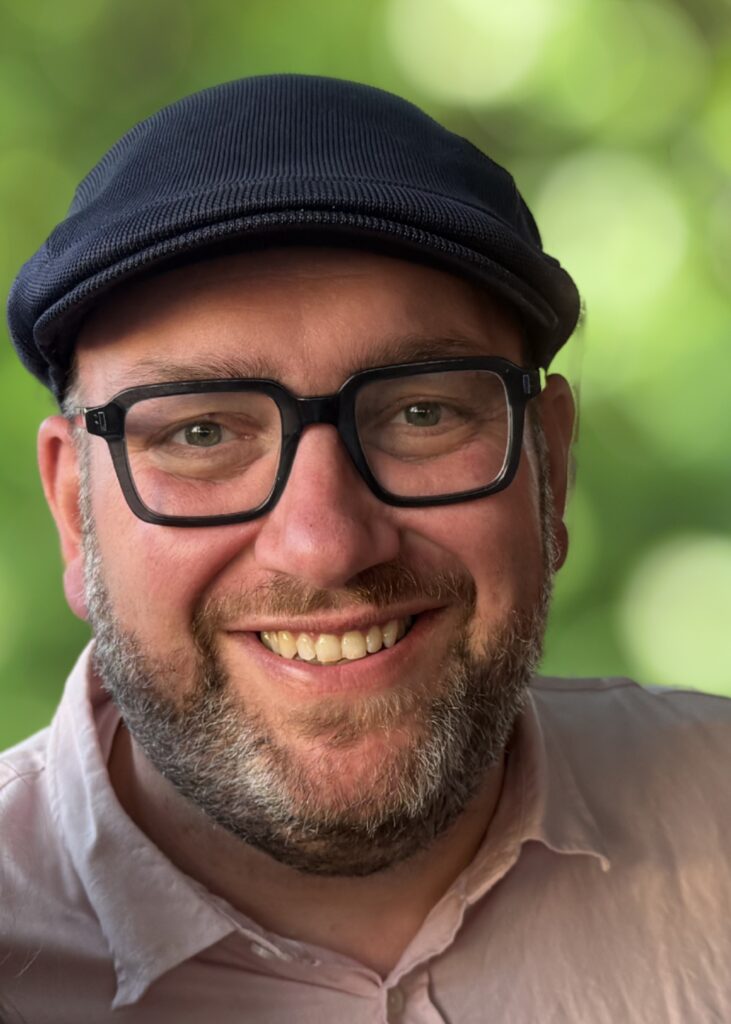
Rabbi Gersh Lazarow is the founding rabbi of Shtiebel, an independent Jewish community in Melbourne dedicated to openness, belonging, and the belief that every person should be empowered to “do Jewish their way.” His work brings together tradition, contemporary thought, and a deep commitment to helping individuals and families celebrate, learn, and live Jewishly with integrity and joy. With more than two decades of communal leadership, teaching, and pastoral work, Rabbi Lazarow is recognised for his thoughtful voice, accessible teaching, and his passion for creating spaces where people can shape meaningful Jewish lives on their own terms. As with much of his writing at Shtiebel, he shaped this piece with the help of AI as an editorial companion — a tool that helps clarify language but not intention. The spirit, teaching, and reflection remain wholly his own.
Praying for Those Who Guard Israel
On Zionism, B’tzelem Elohim, and the Evolution of a Prayer
Over the better part of the past year, I have been writing and rewriting a prayer for those who serve in defence of Israel. It now exists in several forms, some considerably shorter than the full version, and it has changed as I have prayed it in different settings, returned to particular words, removed others, and discovered that some of what I originally wanted to say no longer quite expressed what I needed to pray.
I am not sure I regard even this version as finished. That does not trouble me terribly. Jewish prayer has never really been static. We inherit words, carry them into new circumstances and, occasionally, discover that the words themselves need to stretch.
The prayer is deliberately in conversation with the traditional Mi Sheberach for the soldiers of Israel. That prayer feels considerably older than it is because its language and structure are so recognisably Jewish. Its familiar modern form was composed by Rabbi Shlomo Goren, the first Chief Rabbi of the IDF, in the early years of the State, using the ancient Mi Sheberach form to give liturgical expression to an entirely new reality in Jewish history: Jewish sovereignty accompanied, for the first time in almost two millennia, by a Jewish army charged with defending it.
What I have written is not intended as a rejection of that prayer. In many respects it is an extension of it. Its opening makes the relationship explicit:
מִי שֶׁבֵּרַךְ אֲבוֹתֵינוּ אַבְרָהָם יִצְחָק וְיַעֲקֹב, וְאִמּוֹתֵינוּ שָׂרָה רִבְקָה רָחֵל וְלֵאָה
Mi shebeirach avoteinu Avraham, Yitzchak v’Yaakov, v’imoteinu Sarah, Rivkah, Rachel v’Leah.
May the One who blessed our ancestors Abraham, Isaac and Jacob, and our ancestors Sarah, Rebecca, Rachel and Leah.
The inclusion of the matriarchs is an obvious progressive development of the traditional formula, but otherwise the structure is immediately recognisable. We begin by locating those for whom we pray within a chain of Jewish memory. They are not simply soldiers or representatives of a state; they stand within the continuing story of a people.
The next phrase comes more directly from the traditional prayer:
הָעוֹמְדִים עַל מִשְׁמַר אַרְצֵנוּ וְעָרֵי אֱלֹהֵינוּ
Ha’omdim al mishmar artzeinu v’arei Eloheinu.
Those who stand guard over our land and the cities of our God.
In my English I have rendered and expanded that as “those who stand guard over the land of our ancestors and the homes of our children.” The geography that follows likewise retains the sweep of Goren’s prayer: from the border of Lebanon to the desert of Egypt, from the Great Sea to the approaches of the Arava, on land, in the air and upon the water.
I wanted to retain that geography because the land matters to me. I am a Zionist. I believe that the Jewish people are a people and not merely the adherents of a religion; that we have a profound historical, spiritual and cultural relationship with this land; and that we possess the same right to collective self-determination that I believe belongs to other peoples. I also believe that Israel has both the right and the responsibility to protect those who live within it.
Where my prayer begins to depart from the inherited text is not in its commitment to those who serve, but in the questions I increasingly need to place alongside that commitment. The traditional prayer asks God to send:
בְּרָכָה וְהַצְלָחָה בְּכָל מַעֲשֵׂה יְדֵיהֶם
Bracha v’hatzlacha b’chol ma’aseh yedeihem.
Blessing and success in all the work of their hands.
In the context of war, I have found myself unable simply to pass over that phrase. What exactly do I mean when I ask God to bless the work of a soldier’s hands? What constitutes success? What am I asking God to strengthen, and towards what end?
The Hebrew heading I use at this point is:
רִבּוֹנוֹ שֶׁל עוֹלָם
Ribono shel olam.
Master of the Universe.
It is not a quotation from a single biblical verse, but belongs to the familiar vocabulary of Jewish supplication. Having begun within the inherited Mi Sheberach, the prayer now moves into petition: “Strengthen their hands for the work before them and steady their hearts within it. Grant them clarity when the path is unclear and courage that does not lose its way.”
I want those who defend Israel to have strength, but I cannot pray only for strength. I need also to pray for judgement, restraint and moral clarity in circumstances in which clarity can be desperately difficult to maintain. There is courage in moving towards danger, but there can also be courage in restraint, in recognising limits, and in retaining the capacity to see the human being on the other side of the line. The moral question does not disappear because the military question has become urgent. If anything, the possession of power makes it more urgent.
The next Hebrew phrase comes directly from Psalm 121:
יְהוָה יִשְׁמָרְךָ מִכָּל רָע, יִשְׁמֹר אֶת נַפְשֶׁךָ
Adonai yishmorcha mikol ra, yishmor et nafshecha.
God will guard you from all harm; God will guard your soul.
The psalm continues:
יְהוָה יִשְׁמָר צֵאתְךָ וּבוֹאֶךָ מֵעַתָּה וְעַד עוֹלָם
Adonai yishmor tzetcha uvo’echa, mei’atah v’ad olam.
God will guard your going out and your coming in, from now and forever.
The language is familiar enough that it is easy to overlook how much it contains. In the context of this prayer, the movement from protection against harm towards the guarding of the nefesh has become particularly important to me.
When we pray for those who serve, our first instinct is understandably to pray for physical safety. We want them protected from injury and death and returned to the people who love them. Yet physical survival is not the only meaning of coming home safely. There are experiences that remain long after the immediate danger has passed, things witnessed that cannot simply be unwitnessed, decisions made under impossible circumstances and fear that does not necessarily disappear when the uniform comes off.
So the prayer extends the biblical petition: “Guard them from harm and shield them from the burdens that follow, the fear that lingers and the moments that do not easily fade. Return them safely to their homes, to their families, to their lives. Bring them back whole, in body and in spirit.”
The word “whole” matters. I am not simply praying that they survive. I am praying, in the language suggested by the psalm itself, for the person and for the nefesh.
The prayer then asks:
וְתַחֲזִירֵם לְשָׁלוֹם
V’tachazireim l’shalom.
Return them in peace.
This language sits naturally within Jewish prayer because departure and return are repeatedly imagined through the vocabulary of shalom. Most obviously, Tefillat HaDerech, the Traveller’s Prayer, asks:
וְתוֹלִיכֵנוּ לְשָׁלוֹם וְתַצְעִידֵנוּ לְשָׁלוֹם וְתַדְרִיכֵנוּ לְשָׁלוֹם
V’tolicheinu l’shalom, v’tatz’ideinu l’shalom, v’tadrichenu l’shalom.
Lead us towards peace, direct our steps towards peace, and guide us towards peace.
Here, however, the return I am imagining is not simply geographical. To return l’shalom must also mean returning to the possibility of life beyond war.
At that point the prayer widens, moving from those who serve to those who wait for them:
תֵּן כֹּחַ לַיָּעֵף
Ten koach la’ayef.
Give strength to the weary.
This is not a direct quotation from Isaiah, but a deliberate adaptation of Isaiah 40:29:
נֹתֵן לַיָּעֵף כֹּחַ וּלְאֵין אוֹנִים עָצְמָה יַרְבֶּה
Noten la’ya’ef koach, ul’ein onim otzmah yarbeh.
God gives strength to the weary and increases the strength of those without power.
I have taken the prophet’s description of God and turned it into petition. If God is the One who gives strength to the weary, then give strength now to those who are weary: to those who serve, certainly, but also to “the families who carry love alongside worry, hope alongside uncertainty.”
That movement from inherited text into contemporary petition happens repeatedly throughout the prayer. I have not been interested in assembling a collection of biblical quotations, nor in giving contemporary political ideas a decorative Hebrew veneer. I have tried instead to allow the language of Tanakh and the siddur to become the vocabulary through which the prayer thinks. Sometimes that means quoting a text directly; sometimes changing a pronoun or grammatical form; sometimes turning a biblical description of God into something we ask of God; and sometimes writing new language that consciously inhabits the rhythms of Jewish prayer.
Ten koach la’ayef has also become deeply personal during the period in which I have been writing this prayer. I have become the parent of a child who heard what she understood to be a generational call to service, and that has inevitably changed the way I hear words I have said throughout my rabbinate. “Guard them from harm” is different when I know the face that enters my mind as I say it. “Return them safely to their homes, to their families, to their lives” is different when one of those homes is ours. Asking for strength for those who wait carries a different weight when I have begun, in however small a way, to understand the peculiar combination of pride, love, distance and worry contained within that waiting.
I say that with caution. There are families whose experience of waiting has involved levels of fear, uncertainty and loss that I pray never to know, and I would never collapse my experience into theirs. What has changed for me is simpler: the person inside a uniform has become impossible to abstract. Each is somebody’s child, sibling, partner, parent or friend; somebody whose message is awaited, whose silence is noticed and whose empty chair changes a room.
Perhaps because that has become so personal, the next movement of the prayer has become even more important to me:
בְּצֶלֶם אֱלֹהִים
B’tzelem Elohim.
In the image of God.
The phrase comes from the opening chapter of Genesis:
וַיִּבְרָא אֱלֹהִים אֶת הָאָדָם בְּצַלְמוֹ, בְּצֶלֶם אֱלֹהִים בָּרָא אֹתוֹ
Vayivra Elohim et ha’adam b’tzalmo, b’tzelem Elohim bara oto.
God created the human being in God’s image; in the image of God, God created the human being.
Its location in Torah matters enormously to me. This comes before Abraham and Sarah, before covenant, before Sinai, before the emergence of Israel as a people. The first chapter of Torah makes a claim about humanity before our tradition begins making particular claims about Jews.
Rabbi Akiva develops precisely that universal claim in Pirkei Avot:
חָבִיב אָדָם שֶׁנִּבְרָא בְצֶלֶם
Chaviv adam shenivra b’tzelem.
Beloved is the human being, for the human being was created in the Divine image.
The Mishnah then goes on to speak separately of the particular belovedness of Israel. I find that juxtaposition enormously important. The universal and the particular sit beside one another. Judaism does not require me to choose between loving my people particularly and recognising the Divine image universally.
That is very close to the religious tension I am trying to hold in this prayer. I love my people. I believe in Jewish self-determination and pray for those who defend Israel, including now my own child. At the same time, my Judaism teaches me that before the person standing opposite me is Israeli or Palestinian, Jew or Muslim, friend or enemy, that person is adam: human, created b’tzelem Elohim.
For me, this is one of the theological foundations of my progressivism. I do not experience my progressive commitments as something imported into Judaism from outside. If every human being bears the Divine image, then every human being possesses an intrinsic dignity that I did not confer and therefore cannot withdraw. Nationality does not erase it. Religion does not erase it. A border does not erase it, and war does not erase it.
This is why the prayer says, “Remind them and remind us that every human being is created in the Divine image. Even now. Especially now.” The words “and remind us” are essential. It would be easy, and rather self-satisfied, to write a prayer telling soldiers to remember the humanity of others. The prayer has to place those of us who say it under the same obligation. B’tzelem Elohim is easiest when the person before us is familiar, sympathetic and safe. Its religious force is tested when we are frightened, furious or grieving; when the person before us belongs to a people we have learned to fear; even when that person has acted in ways we find abhorrent.
Recognition of the Divine image does not mean abandoning moral judgement or pretending that every action is equivalent. It means refusing to make another person’s humanity conditional upon that judgement.
Becoming the parent of a soldier has made that insistence more important to me rather than less. If I ask the world to see the full humanity of my child beneath a uniform, then my own religious commitments require me to keep extending that moral imagination outwards. Somewhere on the other side of this conflict is another parent looking at their child and seeing, as I do, an entire world. That recognition does not settle questions of responsibility, justice or defence. It simply prevents those questions from becoming an excuse for withdrawing another person’s humanity.
From there the prayer turns to one of the most familiar phrases of the evening liturgy:
וּפְרוֹשׂ עֲלֵיהֶם סֻכַּת שְׁלוֹמֶךָ
Ufros aleihem sukkat shlomecha.
Spread over them Your shelter of peace.
In Hashkiveinu we ordinarily pray:
וּפְרוֹשׂ עָלֵינוּ סֻכַּת שְׁלוֹמֶךָ
Ufros aleinu sukkat shlomecha.
Spread over us Your shelter of peace.
The change is small but deliberate: aleinu, “over us”, becomes aleihem, “over them”. The shelter we ask God to spread over us each evening is extended over those who stand guard.
There is a paradox in that image that I have always found compelling. A sukkah is a remarkably poor fortress. It is temporary, permeable and deliberately vulnerable. Yet this is the image Jewish liturgy chooses for God’s protection and for peace. We do not ask God to spread over us an impenetrable bunker. We ask for a sukkah.
Placed into a prayer for those who serve, that image takes on another meaning. I want those who defend Israel to be protected, but I do not want us to confuse protection with invulnerability or peace with domination. “Spread over them Your shelter of peace. Guide them in paths of courage and restraint, in choices that honour life even in the midst of its defence.” Life sometimes has to be defended, while the defence of life must remain accountable to the sanctity of life. My Judaism requires me to hold both.
The prayer then turns to another deeply familiar liturgical construction:
וִיהִי רָצוֹן
Vihi ratzon.
May it be Your will.
This is not a quotation from one particular verse. It belongs to the grammar of Jewish prayer itself, the language through which we move beyond describing what is towards daring to articulate what ought to be. Here the aspiration is that “the day comes soon when those who stand guard will no longer be needed.”
I do not understand that sentence as diminishing those who serve. I understand it as perhaps the deepest blessing I can offer them. The measure of our success cannot be that each generation becomes more accomplished at fighting the wars inherited from the generation before it. I want my child to live in a world in which her children are not required to answer the same call she felt compelled to answer, and I want Palestinian parents to be able to imagine that same future for their children.
I want Jewish self-determination to be secure enough that it is not perpetually experienced as existentially precarious, and Palestinian self-determination to become a lived reality rather than an endlessly deferred aspiration. I do not pretend to know the political architecture capable of producing that future. Prayer is not policy, and I think we diminish both when we confuse them. Prayer does, however, allow us to articulate the world towards which we believe our politics and our actions ought ultimately to be directed.
It is in that context that the prayer returns to the work of our hands. Psalm 90 concludes:
וִיהִי נֹעַם אֲדֹנָי אֱלֹהֵינוּ עָלֵינוּ, וּמַעֲשֵׂה יָדֵינוּ כּוֹנְנָה עָלֵינוּ, וּמַעֲשֵׂה יָדֵינוּ כּוֹנְנֵהוּ
Vihi noam Adonai Eloheinu aleinu; uma’aseh yadeinu konenah aleinu, uma’aseh yadeinu konenehu.
May the favour of Adonai our God be upon us; establish the work of our hands for us, establish the work of our hands.
My prayer takes up that language:
וּמַעֲשֵׂה יָדֵינוּ כּוֹנְנָה עָלֵינוּ
Uma’aseh yadeinu konenah aleinu.
Establish the work of our hands for us.
The English then interprets what I want that work to become: “Turn the work of our hands from defence to building, from holding the line to opening possibilities, from surviving toward truly living.”
This may be the line that most clearly expresses my Zionism. The achievement of Jewish sovereignty cannot ultimately be measured by our capacity to fight. History has taught us the terrible cost of Jewish powerlessness, and I have no desire to return to it. But the recovery of Jewish power was intended to make Jewish life possible, not to make power itself the purpose of Jewish life.
We returned to build: homes and communities, schools and universities, language and culture, literature, music, science, families and a society capable of containing all of our arguments about what it ought to become. Defence may sometimes be necessary to protect that work. It cannot become the work itself.
There is also something in the grammar that matters to me. Earlier in the prayer I ask God to strengthen their hands for the work before them. Here the language becomes our hands. The responsibility for building what comes next cannot be placed upon those who serve. Those of us who ask others to stand guard also have to ask what we are doing to make their guarding less necessary.
Finally, the prayer arrives at words so deeply embedded in Jewish consciousness that they scarcely need introduction:
עֹשֶׂה שָׁלוֹם בִּמְרוֹמָיו
Oseh shalom bimromav.
The One who makes peace in the high heavens.
The words originate in the Book of Job:
הַמְשֵׁל וָפַחַד עִמּוֹ, עֹשֶׂה שָׁלוֹם בִּמְרוֹמָיו
Hamshel vafachad imo, oseh shalom bimromav.
Dominion and awe are with God, who makes peace in the high heavens.
Jewish liturgy took those final words and expanded them into the familiar:
עֹשֶׂה שָׁלוֹם בִּמְרוֹמָיו, הוּא יַעֲשֶׂה שָׁלוֹם עָלֵינוּ וְעַל כָּל יִשְׂרָאֵל
Oseh shalom bimromav, hu ya’aseh shalom aleinu v’al kol Yisrael.
May the One who makes peace in the high heavens make peace upon us and upon all Israel.
My prayer extends the circle once again:
עֹשֶׂה שָׁלוֹם בִּמְרוֹמָיו, הוּא יַעֲשֶׂה שָׁלוֹם עָלֵינוּ וְעַל כָּל יִשְׂרָאֵל וְעַל כָּל יוֹשְׁבֵי תֵבֵל
Oseh shalom bimromav, hu ya’aseh shalom aleinu, v’al kol Yisrael, v’al kol yoshvei tevel.
May the One who makes peace in the high heavens make peace upon us, upon all Israel and upon all who dwell on earth.
V’al kol yoshvei tevel is not the conventional ending. I added it because I needed the circle of the prayer to widen once more before it ended. We begin with the particular, praying for those who guard Israel, and we do not relinquish that particularity. But the final aspiration cannot stop at our own boundary. The God to whom I am praying is not only the God of the people for whom I began the prayer, and the peace for which I am praying cannot finally be peace only for us.
That is also why I chose to end with shalom. The traditional prayer for the soldiers of Israel concludes in the language of battle, invoking the biblical promise that God goes with Israel to fight its enemies and bring salvation and victory. I understand that language and the historical circumstances from which it emerged. There are moments when military victory is necessary, and there are enemies who must be defeated. But victory cannot be the final religious aspiration of my prayer.
The final aspiration has to be peace: not a sentimental peace that ignores danger or asks Jews to surrender security, and not a peace that asks Palestinians to surrender dignity, freedom or self-determination, but one large enough to contain the future of both peoples.
Seen in this way, the Hebrew of the prayer moves continually between inheritance and adaptation. Mi shebeirach is inherited and expanded to include the matriarchs. Goren’s geography is retained while its meaning is reframed through the language of ancestors and children. Adonai yishmorcha mikol ra opens into a prayer for physical, psychological and spiritual wholeness. Isaiah’s noten la’ya’ef koach becomes the petition ten koach la’ayef. Ufros aleinu sukkat shlomecha becomes ufros aleihem, placing those who serve beneath the fragile shelter we ask God to spread over us each night. Ma’aseh yadeinu moves from blessing the work before our hands towards asking that the work itself might change. Oseh shalom begins with the familiar prayer for peace upon us and upon Israel and then refuses to stop until that peace extends to kol yoshvei tevel, all who dwell upon the earth.
Alongside those inherited phrases sit pieces of new liturgical language, written deliberately in the register of Jewish prayer. I did not want to write a political statement and then translate it into Hebrew. I wanted the ethical claims themselves to feel at home within the language through which Jews have addressed God for generations. The tradition itself supplies much of the vocabulary through which I understand human dignity, responsibility, restraint, protection, building and peace.
That is also why the different parts of my identity do not feel to me like competing footnotes to the prayer. I am a rabbi, and so I hear contemporary experience through inherited Jewish language and texts. I am a Zionist, and so I pray unapologetically for Israel, for Jewish self-determination and for those who undertake the burden of its defence. I am a religious progressive, and so b’tzelem Elohim is not an uncomfortable qualification to my Zionism but one of the religious commitments through which I understand it. I am committed to the work of peace and building, and so I cannot accept that the perpetual defence of what we have built should become our highest aspiration. And I am now the parent of a child who serves, which has taken all of those questions out of the realm of intellectual argument and placed them somewhere much closer to the heart.
I do not think those commitments fit together neatly, nor am I interested in pretending that they do. There are moments when my commitment to the safety of my own people pulls hard against my capacity to see the fear and suffering of another. There are moments when the universal language of human dignity can feel painfully inadequate in the face of particular acts of brutality, just as there are moments when the language of Jewish particularity can become so consuming that we cease to see anyone beyond ourselves. My task, as I understand it, is not to resolve that tension by discarding one side of it, but to remain religiously accountable to both.
Perhaps that is what I have been trying to do with this prayer for the better part of a year: to write a prayer large enough to contain the things I refuse to surrender. My love of Israel and my belief in Palestinian dignity. My gratitude towards those who defend life and my fear of what war asks of them. My belief in Jewish power and my wariness of what power can do to any of us. My fierce desire for my own child to be protected and my obligation to remember that every parent looks at their child and sees an entire world.
That is why I still do not think of the prayer as finished. Jewish liturgy is a conversation between inherited words and lived experience, and lived experience has an inconvenient habit of continuing. Rabbi Shlomo Goren took an inherited form of Jewish prayer and made it speak to the radically new Jewish reality in which he found himself. I am trying, in a much smaller way and in a very different moment, to remain part of that same conversation: to inherit the prayer seriously enough to preserve what I believe remains essential within it, while allowing it to speak honestly to the moral, spiritual and deeply personal reality in which I now find myself praying.
For now, this is the prayer I can pray. I can ask God to guard those who guard Israel and return them whole, in body and in spirit; that their strength be accompanied by judgement and their courage by restraint; that they, and all of us, remember b’tzelem Elohim precisely when remembering it is hardest. I can pray that the work of our hands might turn, as soon as possible, from defending what we have already built towards building what does not yet exist.
And I can continue to insist, even when so much around us makes that insistence difficult, that the final word of our prayer must still be:
שָׁלוֹם
Shalom.
Peace.
About the Author
Rabbi Gersh Lazarow is the founding rabbi of Shtiebel, an independent Jewish community in Melbourne dedicated to openness, belonging, and the belief that every person should be empowered to “do Jewish their way.” His work brings together tradition, contemporary thought, and a deep commitment to helping individuals and families celebrate, learn, and live Jewishly with integrity and joy. With more than two decades of communal leadership, teaching, and pastoral work, Rabbi Lazarow is recognised for his thoughtful voice, accessible teaching, and his passion for creating spaces where people can shape meaningful Jewish lives on their own terms. As with much of his writing at Shtiebel, he shaped this piece with the help of AI as an editorial companion — a tool that helps clarify language but not intention. The spirit, teaching, and reflection remain wholly his own.