
Rosh Hashanah Evening 5787 – Rabbi Gersh Lazarow
Every year, sometime around the beginning of Elul, I take out my shofar and start practising again.
You would think that after all these years there wouldn’t be much practising required. I know how to blow a shofar. I’ve been doing it every Rosh Hashanah for most of my adult life.
And yet every year I discover that the shofar apparently has other ideas.
Some days the sound is exactly where I left it: other days, absolutely nothing. Or something emerges which, if we’re being generous, might vaguely qualify as an intentional sound.
And my instinct is always the same.
Try harder. More air. More effort. Force the sound out.
It never works.
Eventually I remember what I already know. I put the shofar down. I stop. I take a breath.
And then I begin again.
I’ve been thinking about that as we have approached Rosh Hashanah, because the words we have chosen for these Yamim Nora’im are A Place to Begin Again.
I love that idea. Judaism has this extraordinary confidence in our capacity to begin again.
But there is a prerequisite.
You cannot begin again until you stop.
And stopping is something most of us are not particularly good at. We move from one thing to the next, worrying about tomorrow before today has even finished.
And then Rosh Hashanah arrives and interrupts us.
Our tradition has a word for that moment:
הִנֵּנִי — Hineni
Here I am.
It is the word with which we opened our service tonight, and it appears at some of the great turning points in our biblical story.
God calls Abraham:
אַבְרָהָם, אַבְרָהָם.
הִנֵּנִי.
Moses turns aside at the burning bush:
מֹשֶׁה, מֹשֶׁה.
הִנֵּנִי.
The young Samuel hears his name called in the darkness, without even knowing who is calling.
הִנֵּנִי.
None of them knows what comes next.
Before the journey, before the responsibility, before the future reveals itself, first comes:
Here I am.
And perhaps that is why another great Jewish teacher returned to this word thousands of years later.
Many of you know that I have a habit of referring to Leonard Cohen as one of my rabbis.
Rabbi Cohen.
And I recognise that I probably quote him from this bimah a little more often than is entirely necessary.
Although, in my defence, he keeps giving me good Torah.
Tomorrow we will hear his Hallelujah, and later a powerful adaptation of Who By Fire, Cohen’s encounter with the Unetaneh Tokef.
But what fewer people know is that towards the end of his life, Cohen also returned to the word with which we began tonight.
In You Want It Darker, Cohen wrestles with God, mortality, and a world he cannot entirely understand. And in the midst of it he reaches back into our tradition:
Hineni. Here I am.
And then Cohen takes it one step further:
I’m ready, my Lord.
I think there is something profoundly Rosh Hashanah about the distance between those two statements.
Here I am.
I’m ready.
Readiness doesn’t mean certainty.
Abraham didn’t know what came next. Moses didn’t. Samuel didn’t.
Neither do we.
We don’t know what 5787 will hold for our families, our community, Israel, or the world around us.
Tonight, we don’t need to.
Before the teshuvah, before we ask what needs to be changed or repaired, before we worry about where we are going, Rosh Hashanah asks us simply to arrive.
To stop.
To breathe.
To acknowledge the year we have actually lived — what we got right and what we got wrong, the people we love and those we miss, our hopes, our fears, our gratitude and our disappointments.
Hineni – Here I am.
Tomorrow there will be time to think about where we are going.
Tonight, it is enough to arrive.
And perhaps, once we have truly arrived, we can say with Cohen: I’m ready.
Image credit:
Hineni is based on an original photograph sourced by Rabbi Gersh Lazarow. The accompanying title treatment and graphic design were created with the assistance of OpenAI’s ChatGPT, preserving the original photograph while enhancing it for publication.
About the Author
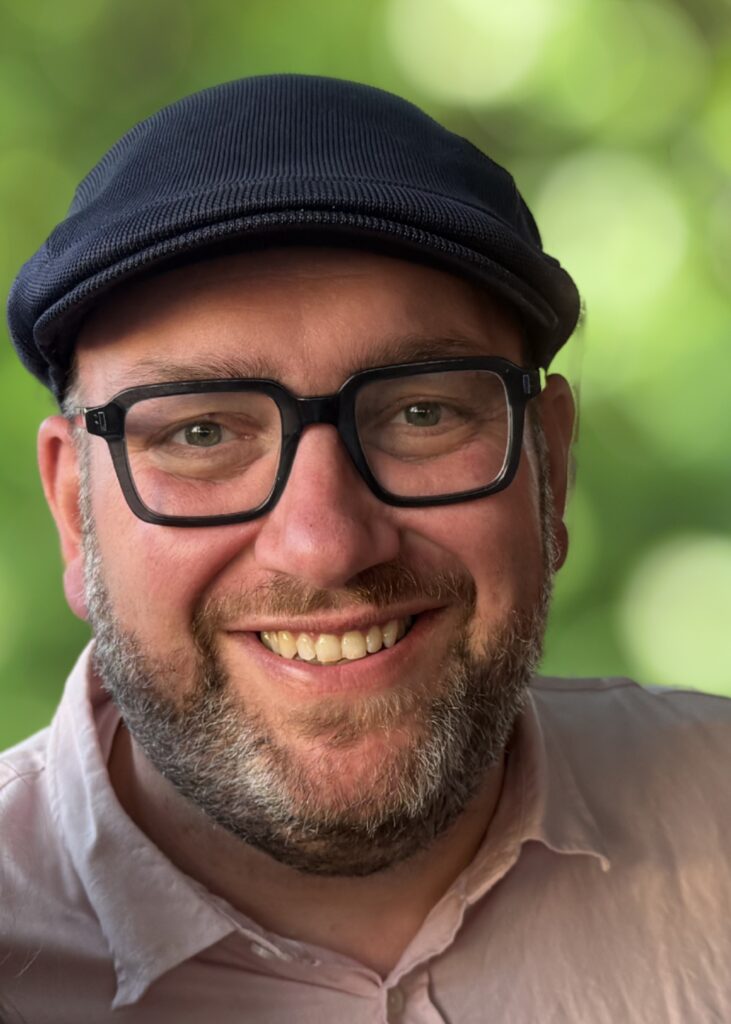
Rabbi Gersh Lazarow is the founding rabbi of Shtiebel, an independent Jewish community in Melbourne dedicated to openness, belonging, and the belief that every person should be empowered to “do Jewish their way.” His work brings together tradition, contemporary thought, and a deep commitment to helping individuals and families celebrate, learn, and live Jewishly with integrity and joy. With more than two decades of communal leadership, teaching, and pastoral work, Rabbi Lazarow is recognised for his thoughtful voice, accessible teaching, and his passion for creating spaces where people can shape meaningful Jewish lives on their own terms. As with much of his writing at Shtiebel, he shaped this piece with the help of AI as an editorial companion — a tool that helps clarify language but not intention. The spirit, teaching, and reflection remain wholly his own.