Yom Kippur Morning 5787 – By Rabbi Gersh Lazarow
Last night, on Kol Nidre, I spoke about what happens when we have been hurt, when a relationship has fractured, when we find ourselves waiting for an apology that may or may not ever come, and about what teshuvah asks of us when we do not actually believe that the wrong was ours.
I want to continue that conversation this morning, but take it somewhere slightly different.
Because relationships do not only fracture because somebody has hurt us. Communities can also come apart because we become so certain of what we believe, and so certain of what somebody else’s beliefs tell us about them, that eventually we lose the capacity to see one another properly.
There is an old story about two brothers who lived on opposite sides of a hill.
They had once been close, but over the years something happened between them. Nobody could quite remember where it began. There had been an argument about the family business, then another about money, then something said at a wedding that should not have been said. Eventually they stopped speaking altogether.
And because they no longer spoke to one another , they began explaining the other.
One brother would say, “I know exactly what he is like. He has always been selfish.”
The other would say, “That is exactly what he does. He thinks only of himself.”
Years passed.
One winter there was an enormous storm. During the night, a tree came down across the road between their homes.
The next morning one brother came outside with an axe and began cutting from his side. A little while later he heard chopping from the other side.
Neither could see the other through the branches.
For several hours they worked, each convinced that he was clearing his own road.
Eventually the final branches fell away.
And there, unexpectedly, they were standing opposite one another.
Neither had crossed the road. Neither had apologised. Neither had resolved the argument.
They had simply removed enough of what had grown between them to be able to see each other again.
I keep thinking about that story this year because I wonder whether we have accumulated so much between us that we can no longer actually see the person standing on the other side.
We are living through an extraordinarily binary moment in history. Left or right. Labor or Liberal. Trump or anti-Trump. Bibi or anti-Bibi. Israel or Palestine. Zionist or anti-Zionist. And even within those categories there are ever smaller tests of belonging, ever more precise ways of deciding who is really with us and who is not.
It is not simply that we disagree. Democracy depends upon disagreement, and Judaism has never been particularly frightened of it. What concerns me is the way disagreement has become a kind of character assessment.
Tell me how you voted and I think I know what kind of person you are. Tell me what you think about Gaza and I think I know how much you care about Jewish life. Tell me what you think about immigration and I think I know whether you are compassionate or racist.
Except… Except, of course, I do not know.
I know one thing you believe, and I have allowed that one thing to become shorthand for everything else I imagine about you.
Perhaps that is why the opening words of our Torah reading have been bothering me this year:
Atem nitzavim hayom kulchem – You stand here today, all of you.
And it is that final word that catches me: kulchem. All of you.
Because Moses does something rather extraordinary. He does not describe a united people by pretending they are all the same. He names their differences: leaders and elders, officials and children, women and strangers, woodchoppers and water-drawers.
Moses has spent forty years with this mob. He knows perfectly well that they are not one great harmonious family.
And yet, still he says kulchem – All of you.
Because Moses and our tradition understands that difference has always existed within the whole.
Perhaps that is the spiritual challenge before us this Yom Kippur. Last night I asked what happens when hurt prevents us from seeing the person on the other side of a broken relationship. This morning I want to ask what happens when certainty does the same thing.
We can see it all around us.
Here in Victoria we are heading towards another election after an unsettled political term, with real arguments about the economy, debt, infrastructure, integrity, crime and public services. Some Victorians look at the state government and see necessary investment in a rapidly growing state. Others see debt, waste and a government that has simply been in power too long. We are watching the growth of One Nation, particularly in regional Victoria, and whatever we individually think of Pauline Hanson or her politics, it is worth asking what that tells us about people who increasingly feel that the established parties no longer speak for them.
We do not have to endorse somebody’s conclusion in order to be interested in how they reached it.
Across Australia we are talking constantly about social cohesion and whether we still feel part of a common project. In Israel, arguments about the government, Gaza, military service, religion and democracy have become arguments about the character of the state itself. And in the United States, politics can seem like two increasingly separate accounts of reality, each with its own media, language, fears and certainties.
And then there is the technology through which we encounter all of this.
Our phones have become extraordinarily sophisticated machines for learning what keeps us looking at them. We click on something because it makes us angry, and we are shown something else that makes us even more angry.
Before long, my feed tells me that every sensible person can see the obvious truth of what I believe…. while your feed tells you precisely the same thing about what you believe.
We think we are looking through a window at the world when increasingly we may actually be looking into a mirror.
And eventually the most outrageous conservative becomes conservatism; the most ridiculous progressive becomes progressivism; the most hostile Palestinian voice becomes Palestinians; the most indifferent Israeli voice becomes Israelis.
The branches get thicker and we can hardly see the person standing on the other side of the road.
And kulchem becomes harder.
Because kulchem requires the possibility that somebody can be wrong about one thing without being wrong about everything. That somebody can vote differently from me without being stupid. That someone can be deeply concerned about Palestinian suffering and still care passionately about Israel, and that someone can be fiercely Zionist and still be profoundly troubled by Settler violence.
Perhaps most confronting of all, it requires me to accept that I can be right about something and still have something to learn.
And then as our Torah portion draws to a close Moses explain why all these very different people are standing together.
They are standing there to enter into covenant.
Not consensus. Covenant.
They are not standing together because they have finally agreed. They are standing together because there is something between them deeper than agreement. Covenant means that my obligations towards you do not disappear simply because we disagree.
That does not mean abandoning moral judgement. Sometimes covenant requires us to say that something is wrong. Social cohesion cannot mean Jews absorbing antisemitism quietly to demonstrate that we are good citizens. Nor can our experience of antisemitism mean that we become indifferent to racism or dehumanisation when it appears elsewhere.
We still have to be able to say, clearly and honestly, “I think you are wrong.”
But the question is what happens after we say it.
Is there still an obligation between us? Can I remain curious about you? Can I allow you to be more complicated than the category into which I have placed you?
And then Moses makes the covenant larger still. He says: this covenant is not only with those standing here today. It is also with those who are not here.
Our tradition reads those words across the generations, and I find that particularly confronting this year because our children are learning something from the way they have watched us disagree.
They are listening around our tables and in our cars. They are watching us watching the news. They are learning whether changing your mind is weakness, whether uncertainty is something to be embarrassed about, whether acknowledging somebody else’s suffering somehow diminishes your own, and whether belonging means being welcome only for as long as you believe the right things.
Those who are not standing here today will inherit the Jewish community and the society that we create through the way we disagree now.
And then, before concluding his teaching, Moses says something that brings all of this together in a way that clarifies and crystallises why we are here today as he explains to those assembled at the foot of the mountain that Lo bashamayim hi – It is not in heaven.
This work is not somewhere beyond us. It is, the Torah says, very close to us. In our mouths. In our hearts. Ours to do.
There are enormous institutional questions facing us. Governments, political parties, media, universities, technology companies and communal organisations all have responsibilities. But social cohesion cannot only be something institutions produce for us.
Eventually it comes down to what we feel in our heart and what we allow to come out of our mouths.
How have we spoken this year about people with whom we disagree?
Have we allowed the most outrageous person on the other side to become our picture of everybody on that side?
Have we called something antisemitic because it really was antisemitic, or occasionally because that was easier than engaging with criticism we did not want to hear?
Whose suffering have we allowed in, and whose have we kept safely outside?
Can we hear someone speak about Palestinian suffering without immediately requiring them to prove that they also care about Israelis?
Can someone speak about Jewish trauma without the immediate response being to explain why somebody else’s pain is greater?
Lo bashamayim hi. It is not in heaven.
The Torah does not ask us this morning to solve the Middle East, repair American democracy or restore social cohesion across Australia before we get to break-fast.
It asks for something much closer.
Not to abandon our convictions. Not to pretend every argument has two equally valid sides. Not even necessarily to cross the road.
Just to clear away enough of what has grown between us to see who is actually standing there.
Maybe there is one person whose view we genuinely do not understand, whom we could ask how they got there, not so that we can change their mind or they can change ours, but simply because understanding another person is itself a way of resisting the binary world.
Maybe the next time our feed offers us something perfectly designed to confirm that the other side is terrible, we might notice what is happening before we click.
And maybe there is simply an and that we need to put back into our vocabulary.
We can be frightened by antisemitism and concerned about Palestinian suffering.
We can love Israel and be deeply troubled by decisions made in its name.
We can care about economic growth and worry about people being left behind.
We can disagree profoundly with somebody and still want to understand them.
The brothers did not cross the road.
They did not resolve the argument.
They simply cleared away enough of the branches to see one another again.
Maybe, this Yom Kippur, that is where we begin.
Because kulchem was never a description of people who had resolved all their differences.
It was a description of a community capable of containing them.
Please, God, we can find a way of ensuring that our community, our state, our country and indeed our people can find a way back to such a place
Atem nitzavim hayom kulchem – You stand here today, all of you.
Ken Yehi Ratzon – May This Be God Will!
Image credit:
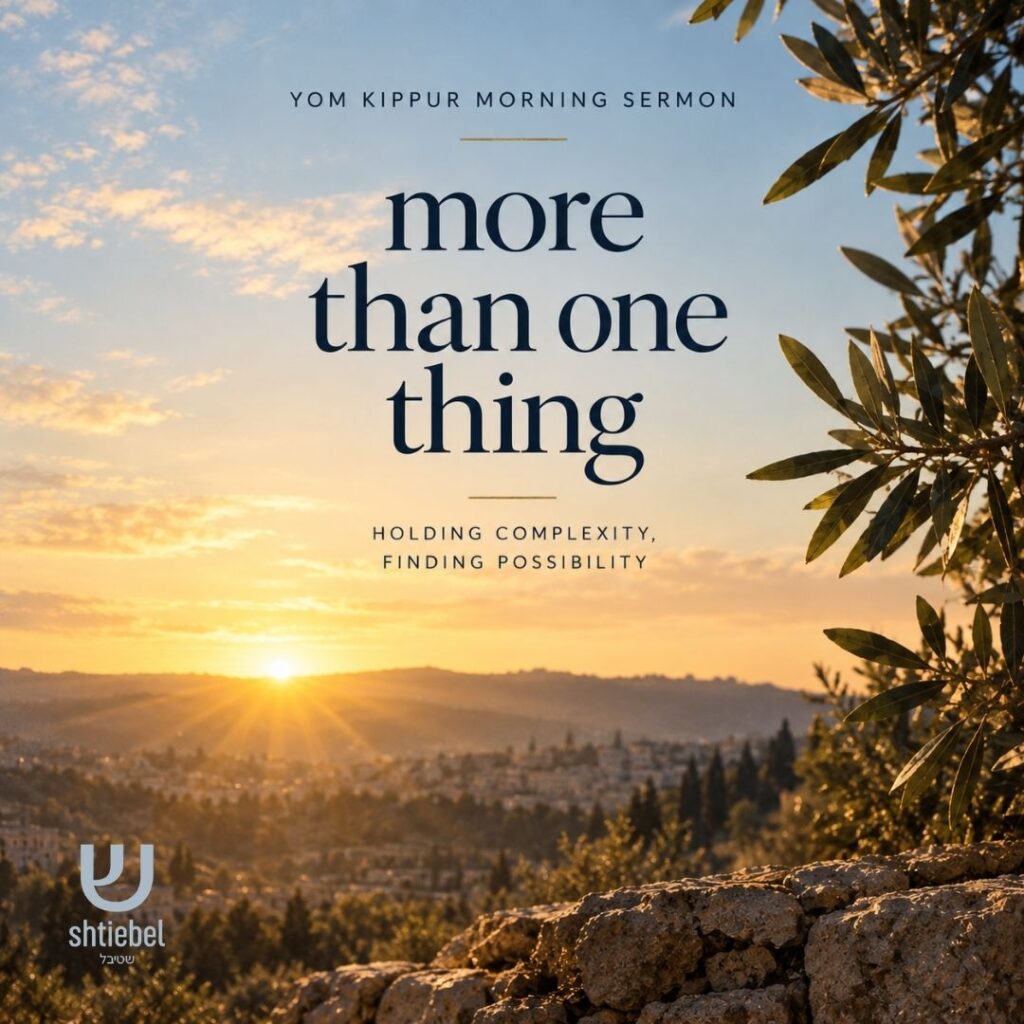
More Than One Thing is based on an original photograph taken by Rabbi Gersh Lazarow. The accompanying title treatment and graphic design were created with the assistance of OpenAI’s ChatGPT, preserving the original photograph while enhancing it for publication.
About the Author
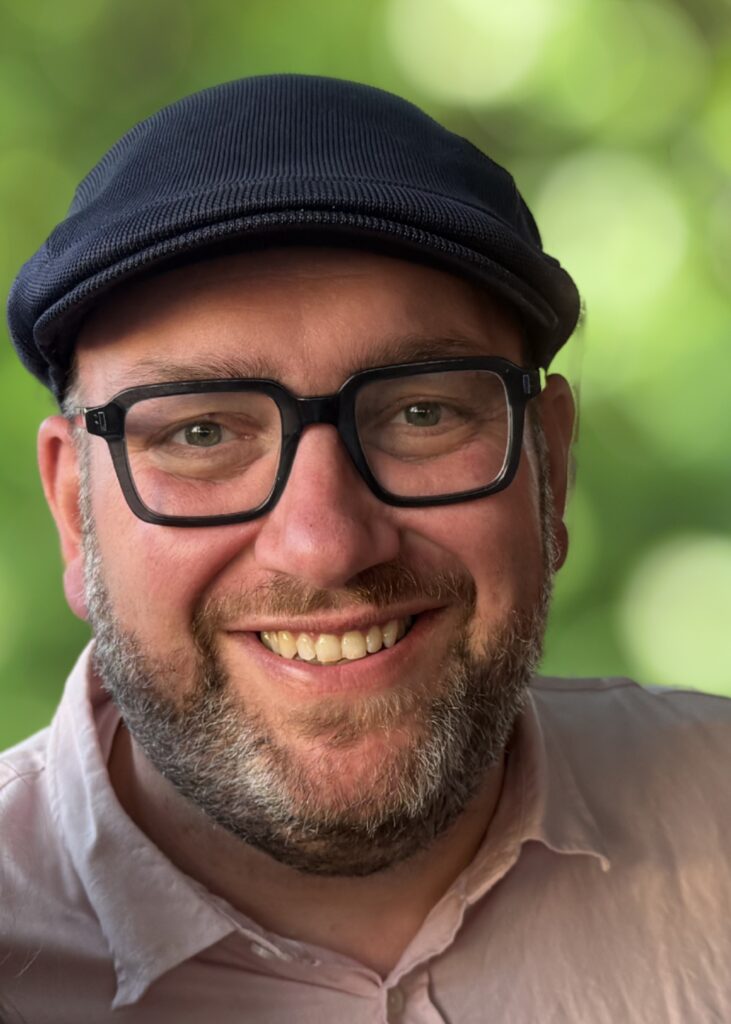
Rabbi Gersh Lazarow is the founding rabbi of Shtiebel, an independent Jewish community in Melbourne dedicated to openness, belonging, and the belief that every person should be empowered to “do Jewish their way.” His work brings together tradition, contemporary thought, and a deep commitment to helping individuals and families celebrate, learn, and live Jewishly with integrity and joy. With more than two decades of communal leadership, teaching, and pastoral work, Rabbi Lazarow is recognised for his thoughtful voice, accessible teaching, and his passion for creating spaces where people can shape meaningful Jewish lives on their own terms. As with much of his writing at Shtiebel, he shaped this piece with the help of AI as an editorial companion — a tool that helps clarify language but not intention. The spirit, teaching, and reflection remain wholly his own.