
Op-Ed By Rabbi Gersh Lazarow
We are not approaching Tisha B’Av.
We are still in Iyar, only weeks from Shavuot, moving towards Sinai, revelation and covenant. And yet my mind keeps returning to one of the most painful stories in the Talmud, a story we usually tell in the shadow of Jerusalem’s destruction.
It begins, not with Rome, but with a banquet.
A man prepares a feast and sends his servant to invite his friend, Kamtza. The servant makes a mistake and invites Bar Kamtza, the host’s enemy. Bar Kamtza arrives and takes his place at the table. Perhaps he thinks the invitation is an opening. Perhaps he imagines an old wound might be healed. Perhaps, for a moment, he allows himself to believe there is room for him.
Then the host sees him.
He demands that Bar Kamtza leave. Bar Kamtza pleads. Let me stay and I will pay for what I eat.
No.
Let me pay for half the banquet.
No.
Let me pay for the entire banquet.
Still no.
The host takes him by the hand and throws him out. The rabbis are there. They witness it. They say nothing.
The Talmud makes an unbearable claim: Jerusalem was destroyed because of Kamtza and Bar Kamtza. Of course Rome destroyed Jerusalem. But our tradition refuses to let us place all the blame outside the walls. It asks us to look at what had already collapsed within: humiliation, exclusion, religious silence and the inability to make room for one another. (Gittin 55b)
That is why the story feels so urgent now.
Two separate legislative moves are being discussed in two different places within Israel’s political system. They are not the same bill and they are not on the same procedural track. But they carry the same spiritual danger.
The first is a renewed “Who is a Jew” proposal, introduced by Religious Zionism MK Simcha Rothman, chair of the Knesset Constitution, Law and Justice Committee. It would amend the Law of Return so that, for aliyah and citizenship, only conversion carried out “in accordance with halacha” would be recognised. In practice, it would invalidate non-Orthodox conversions for immigration and citizenship, and is being considered through the Ministerial Committee for Legislation. (The Times of Israel)
The second is a proposed Western Wall law sponsored by Noam MK Avi Maoz. That bill has passed a preliminary reading and has been sent towards the Constitution, Law and Justice Committee for preparation for its first reading. If passed, it would give Israel’s two chief rabbis authority over Jewish holy sites, including the egalitarian plaza at the Kotel, and define activity contrary to their instructions, including non-Orthodox worship, as “desecration”. (The Times of Israel)
One bill concerns the gates of return.
The other concerns the stones of prayer.
Together, they ask the same question: who owns Jewish belonging?
At Shtiebel, we are an independent Jewish community wholly committed to religious diversity. We welcome people as they are, meet them where they are, and honour the many serious and sacred ways Jewish life is inherited, chosen, discovered, reclaimed, questioned, practised and lived.
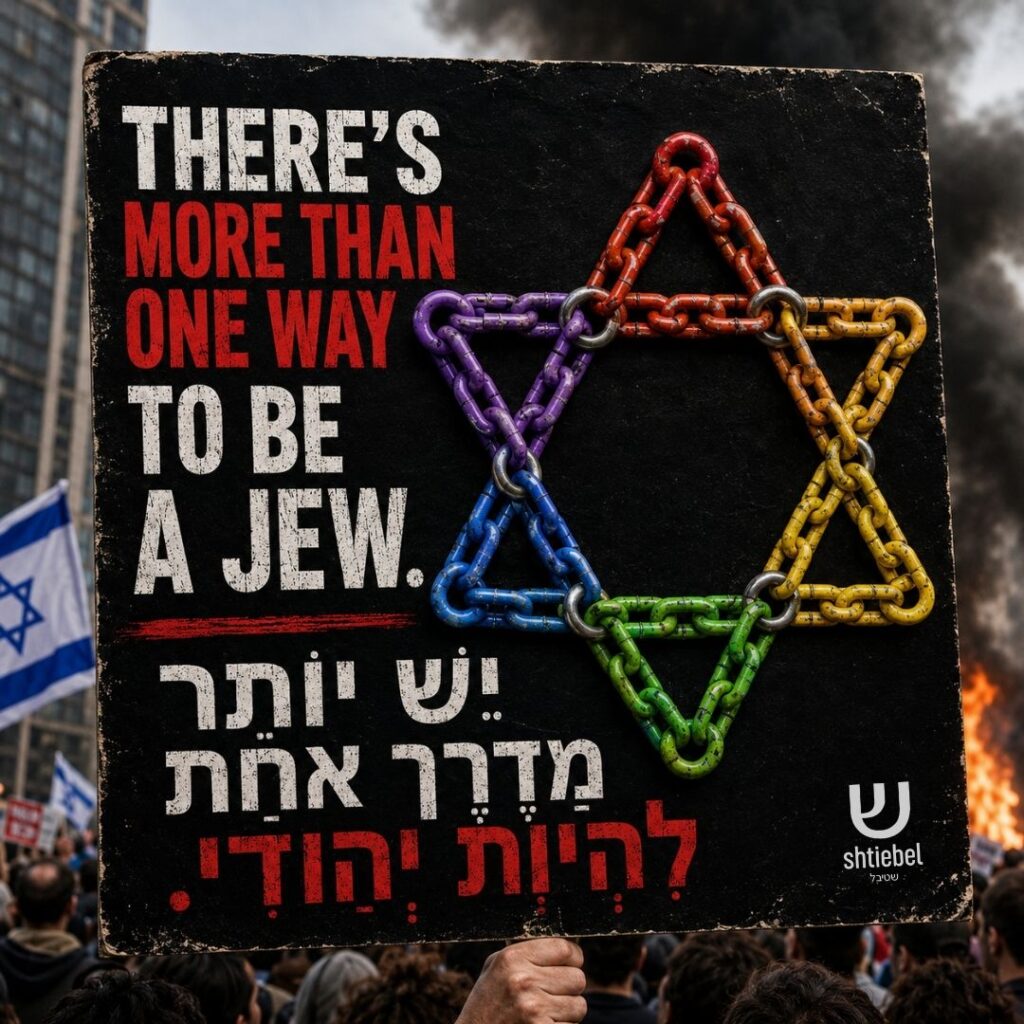
There is more than one way to be a Jew.
That is not a slogan. It is a religious conviction. It is also a Zionist conviction.
We are proudly Zionist and deeply committed to Israel and the Jewish future. It is precisely because of that commitment that we must speak clearly.
The State of Israel is not a private religious court. It is the homeland of the Jewish people. Orthodox rabbis and communities are entitled to uphold their own halachic standards. No one is asking them to abandon their convictions. But when the state privileges one stream of Jewish life and uses that power to deny the legitimacy of others, that is not the protection of Judaism. That is religious discrimination.
And this is not only about conversion.
It is about Jews by choice. It is about people who are paternally Jewish. It is about children adopted into Jewish families. It is about families formed through surrogacy. It is about mixed, blended, searching, returning and deeply committed Jewish families whose lives do not fit neatly inside one Orthodox legal framework.
The Law of Return has never been only a narrow halachic instrument. Since its 1970 amendment, its protections have extended to the child and grandchild of a Jew, the spouse of a Jew, and the spouses of children and grandchildren of Jews. That was a civil Zionist decision. It recognised that Jewish destiny, Jewish family and Jewish peoplehood are broader than one religious test. (The Times of Israel)
The Declaration of Independence promised that the State of Israel would be open for Jewish immigration and the ingathering of the exiles. It promised freedom, justice and peace. It promised equality. It promised freedom of religion and conscience. These were not decorative words. They were the moral architecture of the Jewish state. (Knesset)
To narrow that promise now is not a strengthening of Zionism. It is a betrayal of Zionism’s deepest purpose.
The same is true of the Kotel.
The Western Wall does not belong to one stream, one party, one rabbinate or one government. It belongs to the Jewish people. All of us.
The Jew who davens three times a day. The Jew who has not prayed in years. The Jew who comes with a siddur. The Jew who comes with tears. The Jew who stands in silence. The Jew who sings. The Jew who comes with children, questions, grief, memory, gratitude and longing.
To turn the Kotel into another place where Jews are told they do not belong is to misunderstand the Wall itself.
At a time of rising antisemitism, those who hate Jews do not stop to ask whether a synagogue is Orthodox, Reform, Conservative, Progressive or Liberal before attacking it. They do not ask whether a person is maternally Jewish, paternally Jewish, adopted, converted, cultural, religious, questioning or searching.
They understand what these bills seem to forget: we are one people.
The lesson of Kamtza and Bar Kamtza is not that disagreement destroys us. Jewish life has always held disagreement. The danger begins when disagreement becomes humiliation. When law becomes exclusion. When religious authority becomes a weapon. When leaders see another Jew being pushed from the table and choose silence.
We have paid for that silence before.
This is not yet Tisha B’Av. It is Iyar. Shavuot is before us. Sinai is before us. Covenant is before us.
But covenant cannot be built by throwing people out of the banquet.
Israel must remain a home for the whole Jewish people. Not only for Jews who fit one authority’s definition. Not only for Jews whose families are simple enough to categorise. Not only for Jews whose prayers sound familiar to those in power.
The gates of return must remain wide enough for the Jewish people.
The stones of the Kotel must remain sacred enough for the Jewish people.
The future of Israel must remain generous enough for the Jewish people.
There is more than one way to be a Jew.
And if Israel is to remain our shared homeland, there must remain more than one way to come home.
Image credit:
Shalshelet Kabbalah: The Chain of Tradition is an AI-generated image conceived by Rabbi Gersh Lazarow and created with the assistance of OpenAI’s ChatGPT. The image draws inspiration from the Israel Movement for Progressive Judaism’s campaign for religious diversity from a generation ago.
About the Author
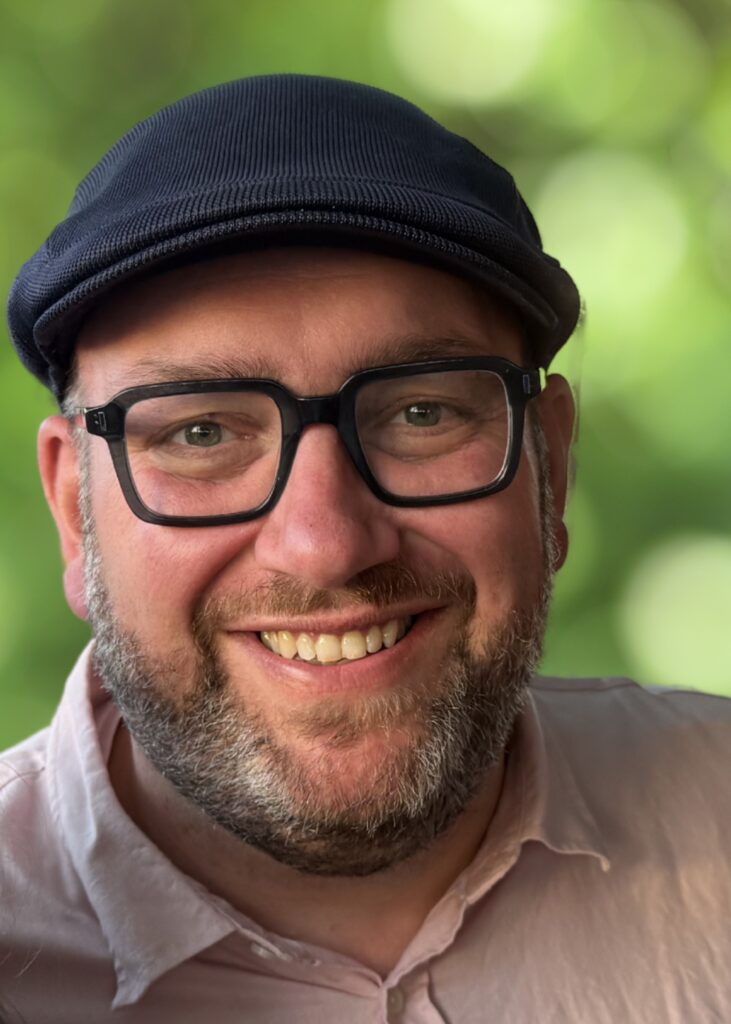
Rabbi Gersh Lazarow is the founding rabbi of Shtiebel, an independent Jewish community in Melbourne dedicated to openness, belonging, and the belief that every person should be empowered to “do Jewish their way.” His work brings together tradition, contemporary thought, and a deep commitment to helping individuals and families celebrate, learn, and live Jewishly with integrity and joy. With more than two decades of communal leadership, teaching, and pastoral work, Rabbi Lazarow is recognised for his thoughtful voice, accessible teaching, and his passion for creating spaces where people can shape meaningful Jewish lives on their own terms. As with much of his writing at Shtiebel, he shaped this piece with the help of AI as an editorial companion — a tool that helps clarify language but not intention. The spirit, teaching, and reflection remain wholly his own.